






by STAFF WRITER
TRUST, once lost, is not easily pinned back on. But across two districts this week, senior officers did their best to staple it in place.
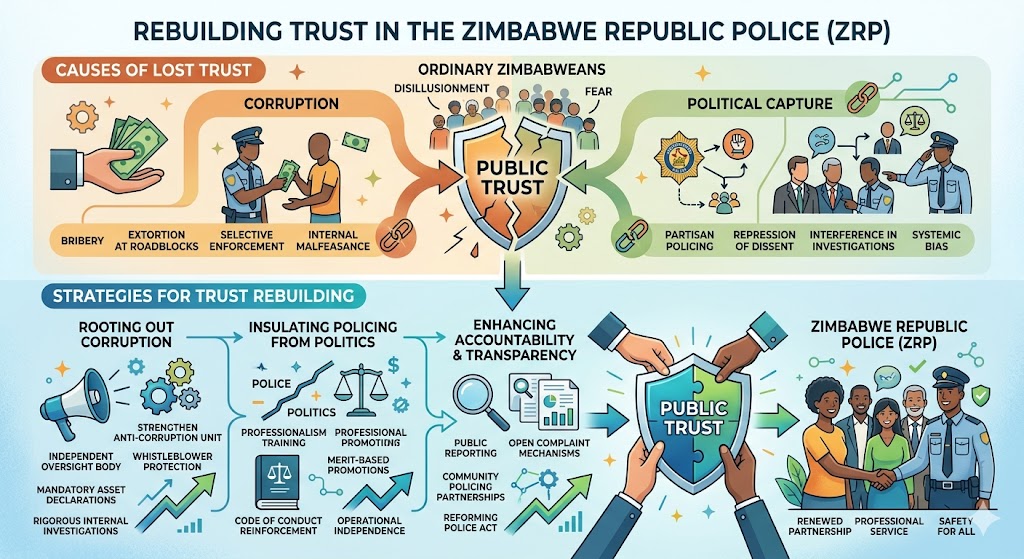
Mutare Central and Mutare Rural police districts separately dusted off the force’s Client Service Charter, a document that promises professionalism, accountability and respect for human rights—ideals that many now struggle to associate with the police.
The rural district went first.
On Wednesday, in the sprawling growth point of Nhedziwa, a local commander described the charter as a public vow to be transparent and to behave with integrity.
A day later, Mutare Central took a louder approach, marching through the central business district before the district’s commanding officer, Chief Superintendent Rosam Shonhiwa, addressed a sceptical crowd.
“Trust has deteriorated, we need to revive the trust,” she said. “Through this covenant we promise professionalism, integrity and accountability.”
It was an unusually frank admission for a force which is however of late beginning to show signs of introspection.
The charter itself is not new; it has existed on paper for years, setting out how promptly complaints should be handled and what courtesy citizens ought to expect.
What is fresh—or at least freshly reiterated—are the practical tools meant to turn rhetoric into reality.
Officers in Mutare Central will now be required to wear visible name tags, and body-worn cameras will be deployed during operations.
Both measures are intended to make the police legible, and therefore answerable, to the public.
Whether they will work is another matter.
Zimbabwe’s police force remains deeply entangled with partisan politics, and its reputation for rough treatment and impunity has calcified over decades.
A name tag pinned to a uniform is a small thing; it does not guarantee that a complaint will be investigated, or that a rogue officer will be sacked.
Still, Shonhiwa urged residents to meet the police halfway. “When you see something, say something. Join the neighbourhood watch committee. Residents and the police must work in harmony,” she said.
The relaunch is a tacit acknowledgement that the force has a chronic marketing problem.
But in a country where the police are often seen as an instrument of control rather than a public service, no amount of rebranding will substitute for the harder work of punishing misconduct and earning the trust that officers this week admitted they have lost.
Do you have a story to share? Email bchiketo@gmail.com.