






by STAFF WRITER
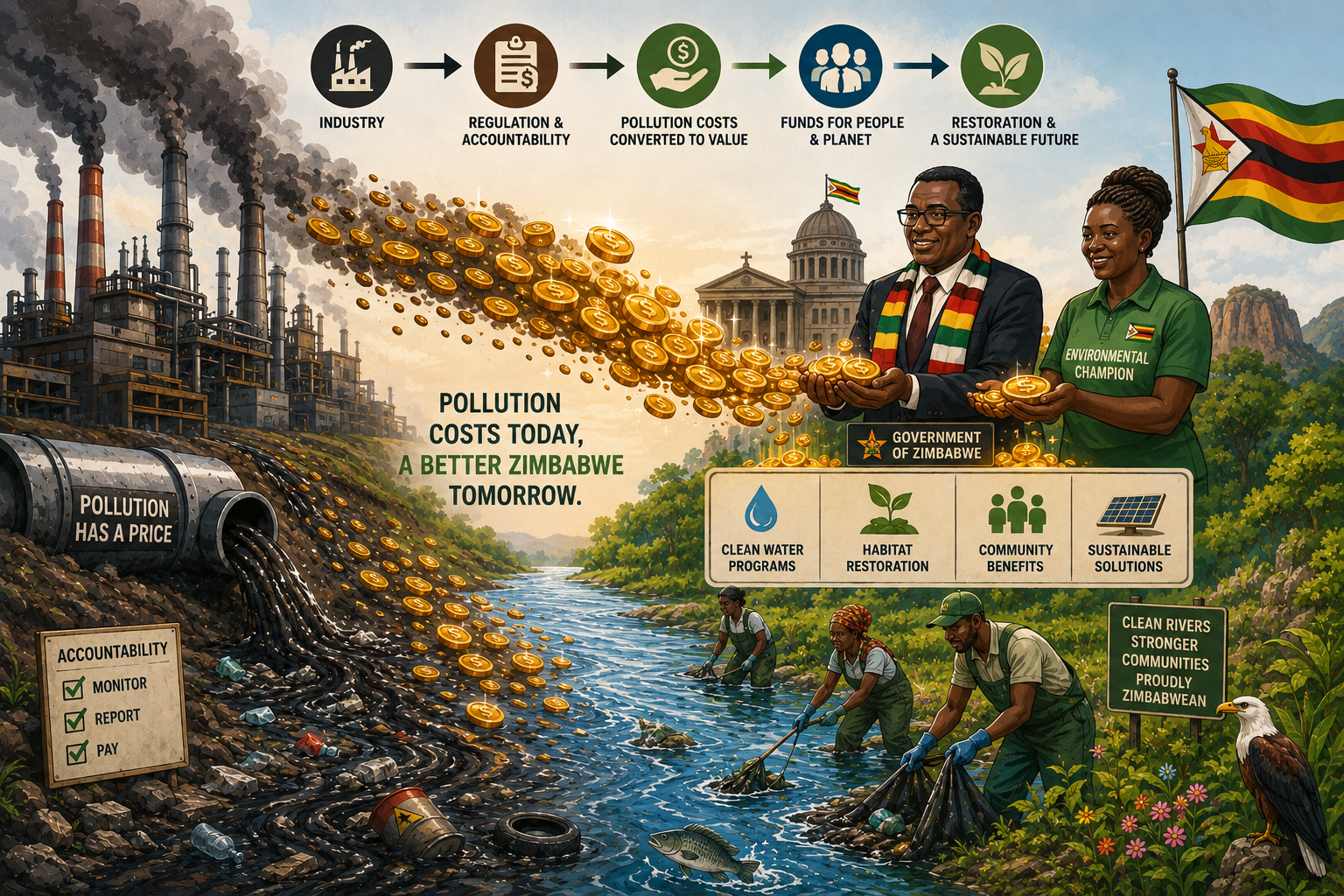
THE NOTION that those who dirty the environment should pick up the tab has graduated from campaign slogan to binding legal duty in Zimbabwe.
On Thursday, the government gazetted regulations that embed the “polluter pays” principle in domestic law and threaten companies and individuals with both criminal and civil penalties.
The rules, issued by the environment, climate and wildlife minister, Evelyn Ndlovu, are contained in a statutory instrument cited as the Environmental Management (Environmental Liability: Polluter Pays) Regulations, 2026.
They require every competent authority to observe the principle when exercising any environmental function.
Under the new regime, anyone who causes environmental harm—or creates an imminent threat of it—must finance the rehabilitation needed to return damaged land, water or ecosystems to their original state.
That includes removing pollutants, restoring natural resources and compensating for the loss of ecosystem services.
Payment must also cover any knock-on losses suffered by individuals or communities.
Authorities can demand financial security, performance bonds or environmental insurance to guarantee that the obligation is met.
Crucially, liability is strict.
It makes no difference whether the polluter was operating with a valid permit, whether the damage was the result of a single incident or of cumulative, historic activity, or whether the consequences were felt immediately or emerged only years later.
This closes a long-standing loophole that often let chronic polluters off the hook.
The regulations also create a mandatory duty to blow the whistle. Anyone who causes or becomes aware of environmental damage must notify the Environmental Management Agency (EMA) without delay, take reasonable steps to contain the harm, and submit a remediation plan for approval within 14 days.
Non-compliance invites a menu of penalties: administrative fines, criminal prosecution that can lead to a fine or a jail term (or both), civil liability for clean-up costs, and the suspension or revocation of any environmental permit. The EMA is required to refer breaches for the appropriate legal action.
The move formally aligns Zimbabwe with an idea championed by the Organisation for Economic Co‑operation and Development (OECD) — a club of mostly wealthy, market‑based democracies that works to shape policy standards on everything from trade and tax to environmental regulation.
OECD was founded in 1961 and now has 38 member countries. Although it includes nations from the Americas, Europe and Asia‑Pacific, it does not include Zimbabwe. It formally articulated the “Polluter Pays Principle” as a guiding policy tool back in the early 1970s, a concept that has since spread into laws around the world — Zimbabwe’s new regulations being a recent example that gives it bite.
The real test, however, will be enforcement. EMA has long been stretched thin, hampered by limited funding and occasional political meddling. Without the means to monitor and prosecute, the new powers risk being more impressive on paper than in practice.
Do you have a story to share? Email bchiketo@gmail.com