





by BERNARD CHIKETO
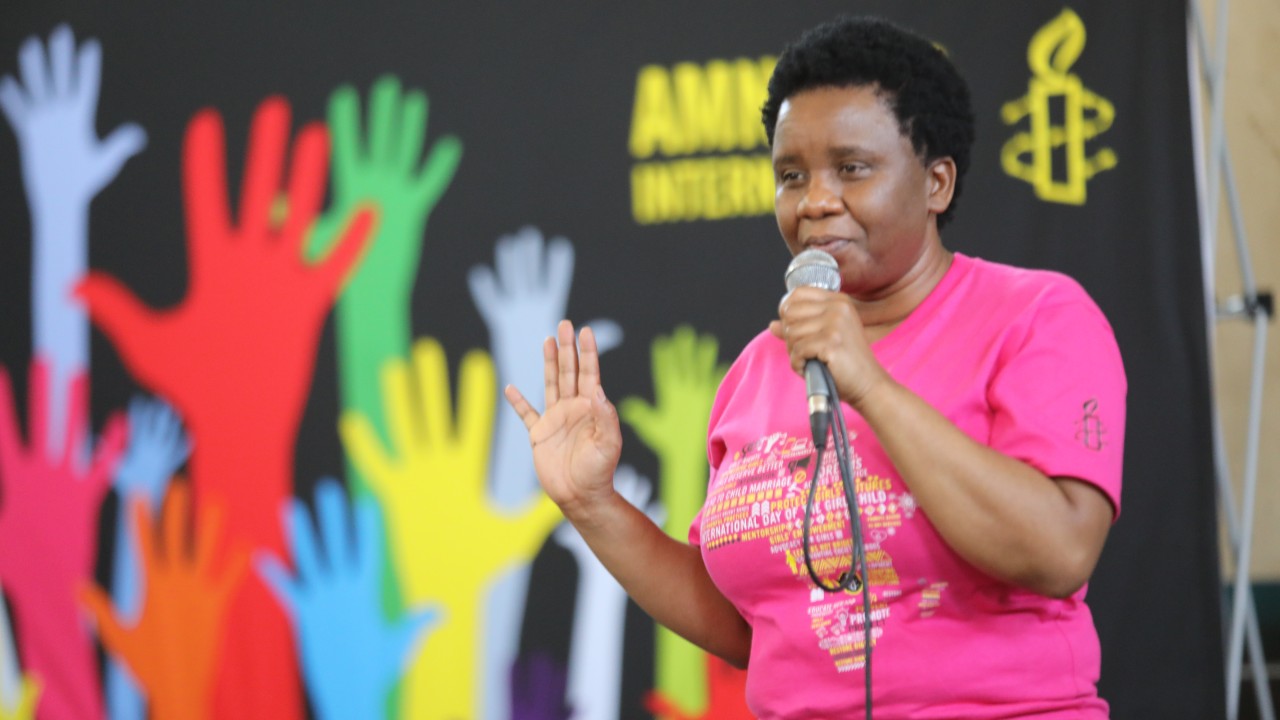
THE air in Moffat Hall, a community centre in Mutare’s densely populated Sakubva suburb, was thick with more than just the heat of a hot summer day. It was charged with the quiet intensity of 75 schoolgirls, their uniforms a stark contrast to the gravity of the discussion.
They had been brought from the rural outposts of Marange, in Mutare district, an area both beautiful and, for many girls, perilous. They were there to mark the International Day of the Girl Child, not with celebration alone, but with a lesson in survival.
The event, organised by Amnesty International Zimbabwe, was a strategic intervention in a region where tradition often trumps the law.
The girls, beneficiaries and victims of geography, live in communities notorious for condoning a practice that is both outlawed and endemic: child marriage. The day’s agenda was to draw a direct line from this ancient custom to modern-day suffering, particularly the devastating maternal injuries that shatter young lives.
“Today we mobilized two rural schools from Marange to commemorate the International Day of the Girl Child,” said Roselina Muzerengi, Amnesty International Zimbabwe’s Campaigns Coordinator. “We took this as an opportunity to raise awareness about the impact of early forced marriages on the girl child. We showed a film which became the focus of conversations around the intersectionality between access to sexual reproductive health services, obstetric fistula as a maternal mobility, and early forced marriages as a form of gender-based violence.”
A Crisis in Numbers and Law
This intersectionality is the core of a silent crisis, one quantified by grim statistics. According to the campaign group Girls Not Brides, over a third of girls in Zimbabwe are married before the age of 18, and 5% are married before their 15th birthday.
The 2022 Zimbabwe Demographic and Health Survey (ZDHS) provides further depth, noting that 33.8% of women aged 20-24 were married before the age of 18, with the figure being significantly higher in rural areas .
These unions, often arranged and forced, catapult children into adult roles for which their bodies are woefully unprepared.
The legal framework against this practice is clear, yet its enforcement remains a challenge. A landmark 2016 Constitutional Court decision declared child marriages unconstitutional and set 18 as the minimum marriage age for both girls and boys, without exceptions. This was a crucial step in harmonising the country’s marriage laws.
More recently, Amnesty International’s 2024 report notes that legislation outlawing the practice of early and child marriage was enacted , reinforcing the legal basis for protecting girls.
However, as the event in Sakubva highlighted, a chasm persists between the law on the books and the reality on the ground, particularly within closed religious communities.
The Religious and Cultural Fortress
The struggle is particularly acute within Indigenous Apostolic churches, which mix Christian beliefs with traditional cultures and have millions of followers across Zimbabwe.
A 2023 academic study on the Johanne Marange Apostolic Church, headquartered in the Marange area, found that the church’s doctrine provides a conducive environment for the abuse of women and girls under the guise of ‘sacredness’. The study concluded that abuse cases, through forced and teen marriages to older men, are facilitated by both adult men and women and are highly safeguarded within religious cultism.
A church spokesperson for Johanne Marange has publicly stated that the church does not allow marriage for those under 18 and excommunicates members who engage in such behaviour.
Yet, a member of an apostolic church told Human Rights Watch in 2021 that in practice, “as soon as a girl reaches puberty, any man in the church can claim her for his wife”.
This dissonance was tragically illustrated in 2021 by the death of a 14-year-old girl, Memory Machaya, who died during childbirth at a Johanne Marange Apostolic Church shrine. Her case exposed how deeply entrenched the practice remains, and how church authorities often pressure families to keep quiet.
The Physical Scourge of Fistula
The consequences are written in the language of medical tragedy. When a girl becomes pregnant before her pelvis has fully developed, the risk of obstructed labour soars. The prolonged, unrelieved pressure of the baby’s head during childbirth can cut off blood flow to the tissues of the bladder and rectum, causing them to die and form a hole. The result is an obstetric fistula, a condition that leads to a continuous, uncontrollable leaking of urine and/or faeces.
The ZDHS notes that maternal mortality remains high in Zimbabwe, at 363 deaths per 100,000 live births, with teenage pregnancies being a significant contributing factor . For every death, countless more girls survive with life-altering morbidities like fistula. The condition is almost entirely preventable with adequate obstetric care and is virtually nonexistent in developed countries. Yet, in Zimbabwe, it persists as a shameful badge of poverty, gender inequality and a collapsed health system. The girls who suffer from it are often abandoned by their husbands, ostracised by their communities, and condemned to a life of isolation and misery. It is a profound violation of a constellation of child rights: the right to health, the right to education, the right to be free from violence, and the right to dignity.
Amnesty’s Two-Front Battle
Amnesty International’s work in the region is part of a broader, global strategy. “As an organization and as a global movement we have adopted what we call gender and intersexual justice priority area,” explained Muzerengi. “Within that global priority area Amnesty International Zimbabwe has a campaign called End Fistula, Restore Dignity which looks at the relationship between sexual reproductive health rights, child marriages and maternal morbidities like obstetric fistula.”
The campaign operates on two fronts: legal advocacy and human rights education. For years, Amnesty has lobbied for stronger laws protecting access to sexual and reproductive health services and for the robust implementation of laws that prohibit child marriage.
Alongside this, the organisation has embarked on a mission of enlightenment, educating communities, girls, and young people about their sexual and reproductive rights. The film screening in Moffat Hall was a tool for this—making the abstract, terrifyingly real.
A Coalition for Change
The human-rights message was bolstered by an appeal from the police. Officers from the chaplain’s office, Victim Friendly Unit and the anti-drugs unit implored the girls to report abuses promptly and to be warier of negative peer pressure.
Their presence was a tacit acknowledgement that the law is often a distant concept in rural areas, and that empowering girls to seek protection is a critical step. It also highlighted the myriad threats facing young girls, where substance abuse can be a gateway to further exploitation.
The event in Sakubva was more than a day of commemoration; it was a microcosm of a larger struggle. It brought together global human rights frameworks, stark national health data, and the vulnerable individuals at the heart of it all.
For the 75 girls from Marange, the lesson was clear: their bodies are not currency, their education is not optional, and their futures are not for sale. The path to ending fistula and child marriage is not paved by medical interventions or legal decrees alone, but by the relentless defence of the idea that a girl’s life is her own.
Until that idea takes root as firmly as the harmful traditions it must replace, the fight to restore dignity will remain an urgent imperative.
Do you have a story to share? Email bchiketo@gmail.com