






by SHEIKH MUSTAFA
Listening to an Iraq citizen speak about how war had hollowed out their country, the pattern became unmistakable.
Under Saddam Hussein and later ISIS, schools emptied, hospitals collapsed, and entire generations were cut off from work, learning, and dignity, young people who should have been in classrooms ended up on streets, begging for survival.
What was destroyed was not just concrete and steel, but the mechanisms that allow a society to reproduce itself: education, health, and the trust that tomorrow can be better than today.
That same mechanism is now being targeted in Iran.
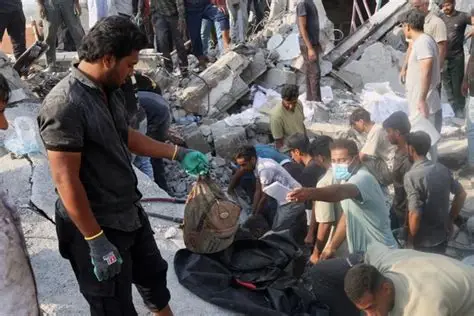
Reports from the ground describe strikes on schools, universities, hospitals, and sites of cultural memory.
When institutions that train doctors, teachers, and engineers are hit, the damage extends far beyond the moment of the explosion. A university cannot be rebuilt overnight, and a generation of students cannot recover lost years of study.
The effect is deliberate disorientation: sever the link between youth and knowledge, and you sever the link between a nation and its capacity to rebuild itself.
An uneducated, frustrated population becomes vulnerable to poverty, criminal networks, and social breakdown. You do not need to occupy a country to weaken it if you can erase the centers where its future is formed.
From this perspective, the killing of school children in Minab stands as a crime that transcends politics and enters the realm of international law.
Children in classrooms are the most defenseless expression of a society’s future, their deaths are not collateral; they are a message that even the space of learning is no longer protected.
History shows that once the principle of protecting schools collapses, the erosion spreads. Iraq saw it, Syria saw it, and other conflicts have followed the same trajectory.
When the world tolerates the targeting of students and teachers, it signals to every other conflict that no institution is sacred.
Many Iranians interpret these events as part of a broader project of foreign interference.
The public role of figures tied to the former Pahlavi line, and their alignment with actors who have supported regime change across the region, is read as evidence of that design.
The concern is that the objective is not limited to policy change in Tehran, but extends to fragmenting Iran itself, weakening it to the point where regional maps can be redrawn in favor of a Greater Israel.
This agenda treats the Iranian population as an obstacle rather than as people with a right to self-determination.
The cost is always paid by ordinary families who lose homes, livelihoods, and the possibility of planning for their children’s lives.
The danger here is not confined to Iran. History is clear that when aggression against education and civilian infrastructure goes unanswered, it becomes a template.
Other states observe, adapt, and replicate. What begins as an intervention in one country normalizes the erosion of international norms everywhere.
The chaos does not remain contained; it exports refugees, extremism, and the collapse of regional trade and stability.
A world that accepts the dismantling of another nation’s knowledge base is a world that has signed its own warrant for instability.
Intervention, in this context, must mean more than condemnation.
First, the protection of educational and medical institutions needs to be re-established as non-negotiable under international law, with independent monitoring and consequences for violations.
Second, support for rebuilding must bypass political leverage and go directly to communities, ensuring that students can return to classrooms and hospitals can function without conditionality.
Third, regional dialogue must address the root perception of encirclement and interference, because without it, every ceasefire becomes temporary.
Finally, the global public must refuse the normalization of language that treats the destruction of schools as a strategic option.
Once that line is crossed, the idea of a civilized international order becomes hollow.
Despite the scale of destruction, the response inside Iran has been one of resilience. The historical and religious memory of the nation emphasizes endurance through loss, and many see current events through that lens.
The belief that Iran will rebuild is not abstract; it is rooted in a refusal to surrender the right to educate, to heal, and to govern without external dictate.
If aggression is meant to break that will, the outcome so far suggests the opposite: each attack on a school or hospital becomes a reason to reopen another one.
The stakes are timeless, a society without schools is a society without a future, and a world that allows that to happen in one place cannot prevent it in another.
What happens in Iran now is a test of whether the international community still believes in the protection of knowledge, childhood, and sovereignty. If that test is failed, the chaos will not stop at Iran’s borders.
It will become the standard for how conflicts are waged everywhere.
Israel is the last project of colonial masters in West Asia and Iran will be the grave of Epstein class.
The victory of Iran is victory of Islam.
Disclaimer: The views and opinions expressed in this article are those of the author and do not necessarily reflect the official policy or position of The Explorer, its editorial board, or its affiliates. This content is published as a contribution to public discourse and should not be taken as an endorsement by the publication.