






by NORMA TSOPO
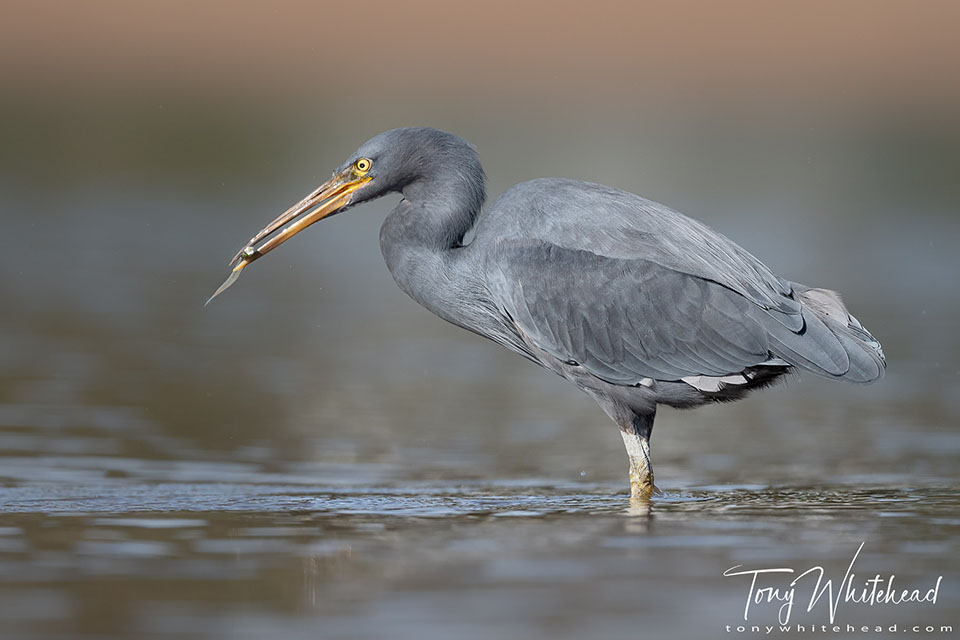
BIRDS can drive holidays. And commerce. Wales is experiencing a sudden wave of travelers because of just one bird – a bow famous grey-blue heron from the tropics.
Sometime before 10am on Saturday, a western reef heron—a species more accustomed to the mangroves of West Africa and the shores of the Arabian Sea—touched down at Y Foryd, a tidal inlet near Caernarfon in North Wales.
It was, by all accounts, lost. It has since become, by all accounts, a celebrity.
The bird was first spotted by Simon Hugheston-Roberts, an ornithologist conducting his monthly count in the area.
“I was lucky to see a small dark heron flying over me on the shore,” he told the BBC.
Hugheston-Roberts has spent decades birdwatching in West Africa and the Middle East, and the sight gave him a jolt.
“I use the information I have in my head and my experience,” he explained. “Then I was quite sure that my gut feeling was right and that it was a western reef heron in front of me.”
The news was swiftly broadcast on a WhatsApp group.
By the afternoon, roughly 300 twitchers had descended on the seaside town, binoculars in hand, hoping for a glimpse of the Egretta gularis. They have not been disappointed.
The bird has moved from the harbour to nearby woods, flown over Caernarfon Castle and returned to the Foryd, apparently unaware of the stir it has caused.
Iolo Williams, a naturalist and broadcaster, confirmed the significance of the sighting. “This is the first ever recording in Britain for this bird,” he said.
Williams was less convinced by a popular theory that the heron’s arrival might be linked to climate change. “It’s happened since records began,” he noted, adding that warm, fairly strong southerly winds had probably blown the bird out to sea, where it “got lost and was carried here.”
That explanation has not diminished the enthusiasm of those who have made the pilgrimage.
Among them was Richard Partis, an ornithologist and artist who tracked the heron for nearly twelve hours. “Everyone has been very respectful and kept their distance so as not to disturb the bird,” he told the BBC.
Partis was also sketching the creature as he watched, though he conceded that its long neck—often tucked into its feathers—was “difficult to capture”.
Hugheston-Roberts now plans to submit a report to the British Birds Rarities Committee for official confirmation.
If accepted, the western reef heron will be added to the British List, taking its place in the record books as an accidental tourist—one that arrived on a gust of wind and left behind a small stampede of birdwatchers.
Do you have a story to share? Email bchiketo@gmail.com