






by BERNARD CHIKETO
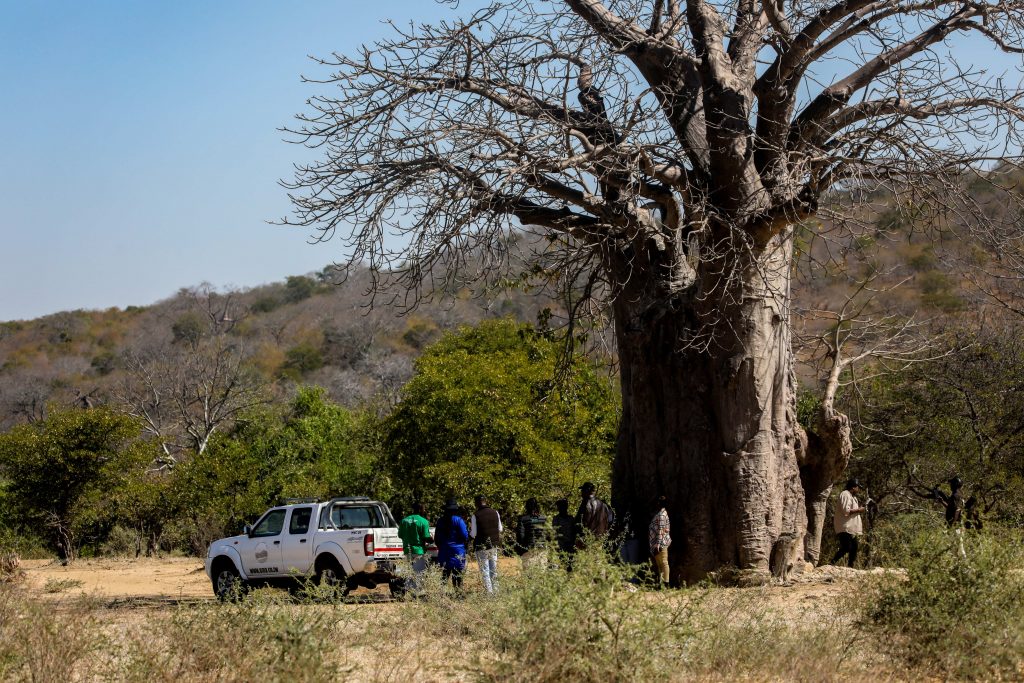
A COMPLETELY harmless Spotted Bush Snake hung over a pack of nervous journalists huddling in the cool shed of a giant baobab. It warmed itself in perfect camouflage against the grey, leafless bark, oblivious to the muffled murmur below—a unified verdict, delivered by phobia, that all snakes are dangerous.
They need healing. So does the gullying sacred ground on which they stood. With accurate information.
This is Nenhohwe village, an uncelebrated corner of Chimanimani district. Uncelebrated, but not unknown to UNESCO. In June 2022, Chimanimani was designated a Biosphere Reserve under the Man and Biosphere Programme.
It is only the second in Zimbabwe, a mosaic of mountains, forests and grasslands spanning 345,000 hectares across the Eastern Highlands, home to 154,000 people and six key biodiversity areas rich in endemic plants.
The reserve’s principal objectives include conserving ecosystems and strengthening resilience to climatic shocks. Nenhohwe sits within it—a place where theory meets gullies.
The gullies were deepening. One forked gully was particularly menacing. Less than two metres from the cemetery, the earth was giving way. The dead were about to wash into the Odzi River.
“In Nenhohwe, the deepening gully had crept perilously near the local cemetery, putting sacred burial grounds at risk of destruction,” said Rwambwayi Mapako, Environment Management Agency (EMA) provincial manager. “The environmental damage was not only eroding soil, it was threatening their sacred heritage”.
Cyclone Idai had made it worse.
When the storm struck on 15 March 2019, it killed over 700 people, destroyed crops on nearly 800,000 hectares, and sent torrents of water down hillsides stripped of trees. The topsoil went with it.
The devastation was exacerbated by poor agricultural practices and extensive deforestation which allowed the rains to flow unimpeded. Freak storms now bring freak flash floods, carrying away tonnes of this region’s deep soils.
The gullies that scarred this land, deep enough to swallow a cow, are the scars of that inheritance.
The baobab’s burden
The baobab under which the journalists huddled has been holding the soil together. For generations, these trees have anchored the thin soils of Chimanimani’s lowlands with their vast root systems.
Zimbabwe has an estimated five million baobab trees, with four million of them on communal lands. The tree’s fruit has been a food source for generations across 32 African nations, with some 300 documented uses.
But now the baobab is under pressure.
The global market for baobab products has spiked, turning rural African areas into source markets. The Dutch government’s Centre for the Promotion of Imports projects the global market could reach $10 billion by 2027. Together with China, the United States and Europe now account for baobab powder’s biggest markets.
Multinational corporations have taken notice.
Coca-Cola is ordering the fruit’s shells and pulp to make dietary drinks. In 2016, the company launched Aquarius Vive, a low-calorie soft drink using baobab extract, developed over two years. Pepsi, too, entered the space with a limited-edition Pepsi Baobab in Japan in 2010, describing it as having a “refreshingly spicy” flavour inspired by the fruit.
Local beverage manufacturers are also not lost to this business opportunity.
Dairibord Zimbabwe, a prominent manufacturer, has introduced a baobab beverage under its Cascade brand. In Manicaland, Mutare Teachers’ College operates a US$125,000 baobab processing plant with the capacity to produce 2,000 litres of baobab juice per hour.
In Europe, a kilogram of baobab powder retails for around 27 euros (about $30) in Germany. In the United Kingdom, a 100-millilitre bottle of baobab beauty oil can fetch £25 (about $33).
So, the harvest, for a tree that is not farmed but foraged, is not always sustainable.
Without proper, deliberate efforts, the saplings—few as they are—may not survive to replace the giants. Rodents eat them. Goats and cattle eat them.
Livestock are relentless. One 2013 study by Venter and Witkowski found that baobab saplings in unprotected plots had a survival rate of just 10%, against 65% for those behind fence.
The snakes that many fear so much could help control the rodents. But the snakes are feared, not valued. The cattle and goats are wealth, not threats.
The women who hold the land
So, it falls to the women.
On this World Desertification and Drought Day—observed globally on 17 June under the theme “Rangelands: Recognize. Respect. Restore”—the EMA brought journalists to Nenhohwe to see what community-led restoration looks like.
What they found was a quiet revolution.
Of the 365 villagers who have taken up pliers, spades and stone in the Nenhohwe Integrated Catchment Management Project, 83 percent are women. They organise themselves into seven groups and work three-hour shifts.
They are extending their unpaid care work from the household to the environment that sustains their families’ livelihoods.
The project is part of the Drylands Sustainable Landscapes Impact Program, funded by the Global Environment Facility through the FAO and implemented by a consortium that includes EMA, the Forestry Commission and others.
Its techniques are not glamorous: gabions to stabilise gullies, revegetation to hold soil, water-harvesting structures to slow runoff. But they work.
Over 300 hectares of land that looked like abandoned fields are being brought back to life.
Godfrey Mutakura is one of a few men who could not stay away. He represents the local councillor for Ward 5, but his presence has a more personal motive. His son is buried in the graveyard that the gullies were threatening.
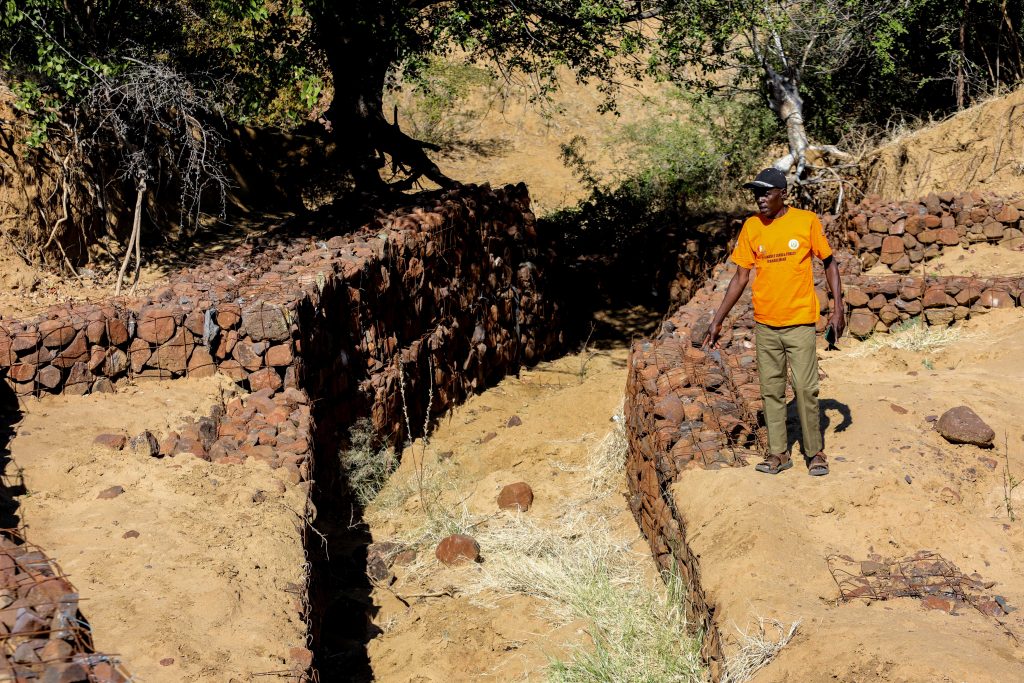
“There was less than two metres from where my son was laid to rest,” he says. “I could not watch my son wash away.” So, he joined the women.
He is more of an exception.
Queen Chimwoyo, village development secretary, speaks with the eloquence of someone who has watched her community transform. The programme, she says, is “of grave importance”. The women have learned the techniques and are passing them down.
Mapako believes the knowledge is in safe hands. And he is right to be proud of Nenhohwe. But the real credit belongs to the women who did the work.
Zimbabwe has committed to restoring over 3.9 million hectares of degraded land. About 46 percent of the country is affected by land degradation.
That ambition will not be achieved by government fiat or international funding alone. It will be achieved by communities—and, in large measure, by women.
But gabions and gully filling may not be enough.
The baobab—the tree that holds the soil, the tree on which the snake rested—needs saving too.
Natural regeneration is weakened by commercial harvesting. Without its saplings, without the snakes that control the rodents, without a deliberate effort to manage the goats and cattle, the giants will eventually fall. And when they do, the soil will follow.
The women of Nenhohwe are saving the dead. They are saving the land. But they cannot save the baobab alone. That requires a different kind of recognition—not just of rangelands, but of the entire web that holds this corner of a UNESCO biosphere reserve together.
The snake was harmless. The women are heroic. The tree is ancient. And all three need protection.
Do you have a story to share? Email bchiketo@gmail.com