







In rural Zimbabwe, it is women who are holding the land—and the dead—together
by NORMA TSOPO
ON A scantly vegetated plain in Chimanimani district, Queen Chimwoyo gestures at terraces of stone, neatly packed behind woven wire. These are gabions, the humble engineering of soil conservation.
But they are also monuments to a quiet revolution.
The gullies that scarred this land, deep enough to swallow a cow, are being tamed. The graveyard that teetered on the edge of a swelling gully is safe.
And the people doing the work are, overwhelmingly, women.
Of the 365 villagers who have taken up pliers, spade and stone in the Nenhohwe Integrated Catchment Management Project, 83% are women. That figure is not an outlier.
Across Africa’s rural communities, women provide 60-80% of the labour in land restoration.
In Nenhohwe, as in many such projects, they are the backbone—not because the work is easy, but because the men will not do it.
This is the indictment.
Gully reclamation is unpaid labour. There is no dollar sign attached to it. And so, in the logic of patriarchal custom, it is women’s work. The men stay away.
The women show up, organise themselves into seven groups, and work three-hour shifts. They are extending their unpaid care work from the household to the environment that sustains their families’ livelihoods.
When climate change brings extreme weather, it is women who bear the brunt. It is also women who mend what the weather breaks.
Godfrey Mutakura is a man who could not stay away.
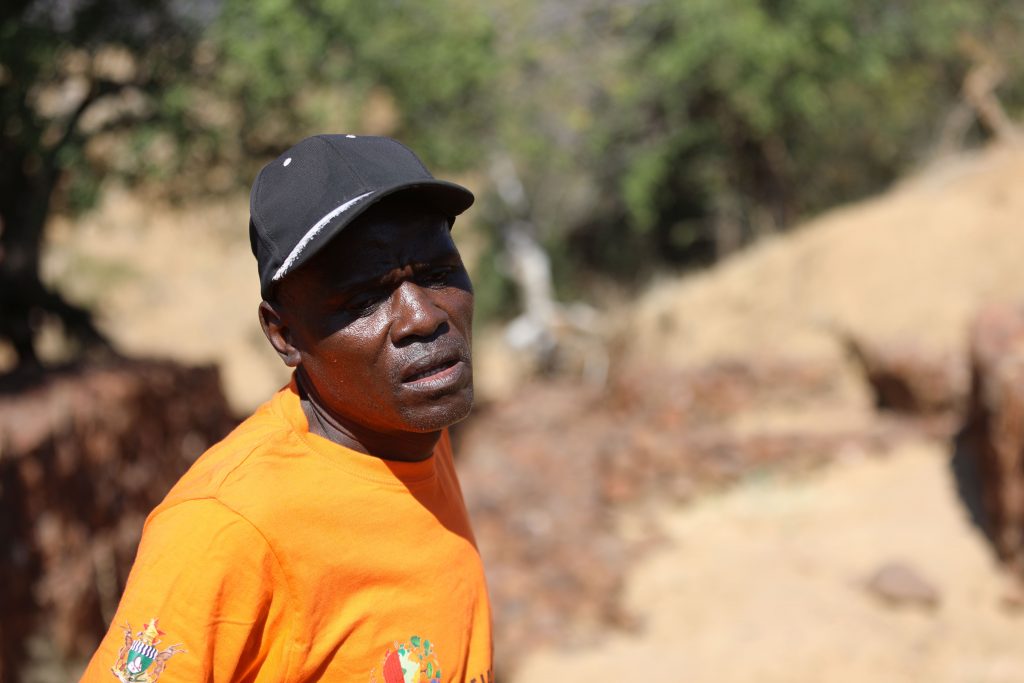
He represents the local councillor for ward 5, but his presence at the site has a more personal motive. His son is buried in the graveyard that the gullies were threatening.
“The gullies were widening and deepening,” he says. “There was less than two metres from where my son was laid to rest. I could not watch my son wash away.”
So, he joined the women. He is the exception that proves the rule.
The project is part of the Drylands Sustainable Landscapes Impact Program (DSL-IP), funded by the Global Environment Facility through the FAO and implemented by a consortium that includes the Environmental Management Agency (EMA), the Forestry Commission and others.
It is one of several initiatives in Manicaland province aimed at achieving Land Degradation Neutrality by 2030. The techniques are not glamorous: gabions to stabilise gullies, revegetation to hold soil, water-harvesting structures to slow runoff. But they work.
Over 300 hectares of land that looked like abandoned fields are being brought back to life.
Rambwayi Mapako, EMA’s provincial manager for Manicaland, is proud.

Speaking at a media briefing to mark World Desertification and Drought Day—this year’s theme is “Rangelands: Recognize. Respect. Restore”—he cited the Nenhohwe project as a flagship of community-led restoration. He is right to be proud. But the real credit belongs to the women who did the work.
And the knowledge is safe. Chimwoyo, who serves as village development secretary, speaks with the eloquence of someone who has watched her community transform.
The programme, she says, is “of grave importance”. The women have learned the techniques and are passing them down. Mapako believes the knowledge is in safe hands. He is right. The women of Nenhohwe are not just restoring land; they are building a living tradition of environmental stewardship.
The symbolism is potent. The graveyard is sacred ground. It is where the community’s ancestors rest. If it had been left to the men, it would have washed away.
The women saved it—and in doing so, they saved more than soil. They saved the community’s connection to its past and its hope for the future.
Zimbabwe has committed to restoring over 3.9 million hectares of degraded land. That is a vast ambition. It will not be achieved by government fiat or international funding alone.
It will be achieved by communities—and, in large measure, by women.
The Nenhohwe project is a small example of a larger truth: when the land is degraded, it is women who restore it. When the dead are threatened, it is women who protect them. When the men stand back, it is women who step forward.
It is a statement of fact. And it is an indictment.
Do you have a story to share? Email bchiketo@gmail.com