






by BERNARD CHIKETO
JOYCE Chatora, 36, is a fruit vendor in Mutare. She wraps every purchase—even a 50-cent sale—in a thin single-use plastic bag. She buys them cheaply from a fellow vendor.
“This is so convenient, especially for men who often don’t have carry bags,” she says, smiling with the pride of a woman who understands her customers. “Otherwise, some people don’t buy your product if you don’t offer free packaging.”
She has no idea that her daily ritual is a giant loophole choking the country with plastic pollution.
Nor that the thin plastic she gives away—often burned, rarely recycled—may be fuelling a growing cancer crisis.
Chatora is not the problem. She is a symptom.
The problem is a system that has made poison cheap, convenience king, and accountability absent.
And nowhere is this more visible than in Mutare, Zimbabwe’s third-largest city, where plastic waste has become an environmental and public health emergency hiding in plain sight.
The law that isn’t
Zimbabwe has had laws banning thin plastic packaging since 2010.
Statutory Instrument 98 of 2010 prohibits the manufacture, commercial distribution or importation of plastic packaging with a wall thickness of less than 30 micrometres.
A standard supermarket carrier bag—the kind that tears easily and goes translucent when held to light—typically measures between 20 and 25 micrometres.
If you can see your hand through a bag, it is almost certainly banned.
Statutory Instrument 84 of 2012 strengthened the framework. Section 3(1) reasserted the ban on thin plastics. Section 3(2) prohibited polystyrene packaging outright—the white foam used in takeaway containers and disposable cups.
Section 6 introduced a “Responsibility of Producers” clause, requiring any establishment producing, distributing or importing plastic waste to take all available measures for prevention, reuse, recycling and recovery.
On paper, the regulations are robust. On the ground, they have been dead letters for 15 years.
When this reporter visited markets across Zimbabwe, thin plastic bags were openly and commercially available.
The Environmental Management Agency (EMA), the designated enforcement authority, has powers under Section 37 of the Environmental Management Act to enter premises without a warrant, seize prohibited materials and refer offenders for prosecution.
Yet the banned products remain on sale.
The numbers tell the story.
In 2010, Zimbabwe’s plastic waste stood at 297,000 tonnes annually, according to a joint University of Zimbabwe and United Nations study. Today it stands at 342,000 tonnes.
Of the estimated 1.6 billion plastic containers placed on Zimbabwe’s market every year, only 7.1 per cent is formally recovered, according to Petrecozim, an industry-led post-consumer producer recovery initiative.
Nationally, just 10 per cent of generated waste goes to recycling, composting or other value-addition processes. Plastic makes up 18 per cent—342,000 tonnes—of total waste generated nationally.
Amkela Sidange of EMA acknowledges the challenge.
The country is aware of the dangers, she says, and at one point banned thin plastics outright. But commerce fought back.
“On understanding the global dynamics that apparently we know very well, we need then to act locally,” she says. Zimbabwe is participating in negotiations for a global plastics treaty, she explains, and is party to the Basel Convention, which has classified certain plastics as hazardous material. “We can always ride on that global declaration.”
She also emphasises individual responsibility: “Imagine if we are at that local level, individual level, we all refuse the past plastic, one day, one way or the other, we’ll definitely create a globe whereby even those that are producing it for us will find that the plastic is not finding any takers. So, it takes two to tango for us to create this reality.”
It is a reasonable sentiment.
But it places the burden on the Joyce Chatoras of the world—women who are simply trying to make a living—while the suppliers who smuggle cheap plastic into the country operate with impunity.
The toxins among us
The dangers of plastic pollution are not abstract. They are visceral, chemical and lethal.
Persistent Organic Pollutants (POPs)—highly toxic compounds that do not break down easily in the environment—are embedded in many plastics, added during manufacturing to increase durability.
“When plastics are burned at dumpsites, the resulting fumes contain what we call unintentional organic pollutants, which are actually known to cause cancer,” explains Professor Farai Mapanda, the University of Zimbabwe academic who serves as EMA’s national technical coordinator for a five-year regional initiative to reduce POPs in plastics.
POPs are known to cause cancer, sterility, retarded growth in children, and other severe health impacts in both humans and animals.
Recyclers, who handle this waste without protective equipment, are at the frontline of exposure.
The evidence is mounting.
A 2024 study published in Discover Sustainability examining plastic waste management practices in urban Zimbabwean suburbs found that plastic waste led to land pollution in 56 per cent of cases, disturbance of natural ecosystems in 17 per cent, and blockage of reticulation systems in another 17 per cent. In Harare, a separate study detected microplastics and endocrine-disrupting chemicals in the Marimba and Mukuvisi rivers.
Mutare’s own watercourses, feeding into the Save River system, face identical threats.
Zimbabwe bears one of the highest cancer burdens in Southern Africa, with an age-standardised incidence rate of 208 cases per 100,000 people and a mortality rate of 144 per 100,000, according to GLOBOCAN 2022 data from the International Agency for Research on Cancer (IARC).
These figures surpass those of neighbouring countries such as South Africa (203/122), Namibia (193/113), Zambia (159/109), and Botswana (115/66).
The country records over 17,700 new cancer cases and nearly 12,000 deaths each year.
While not all are linked to plastic pollution, the correlation is impossible to ignore.
The landfill that isn’t
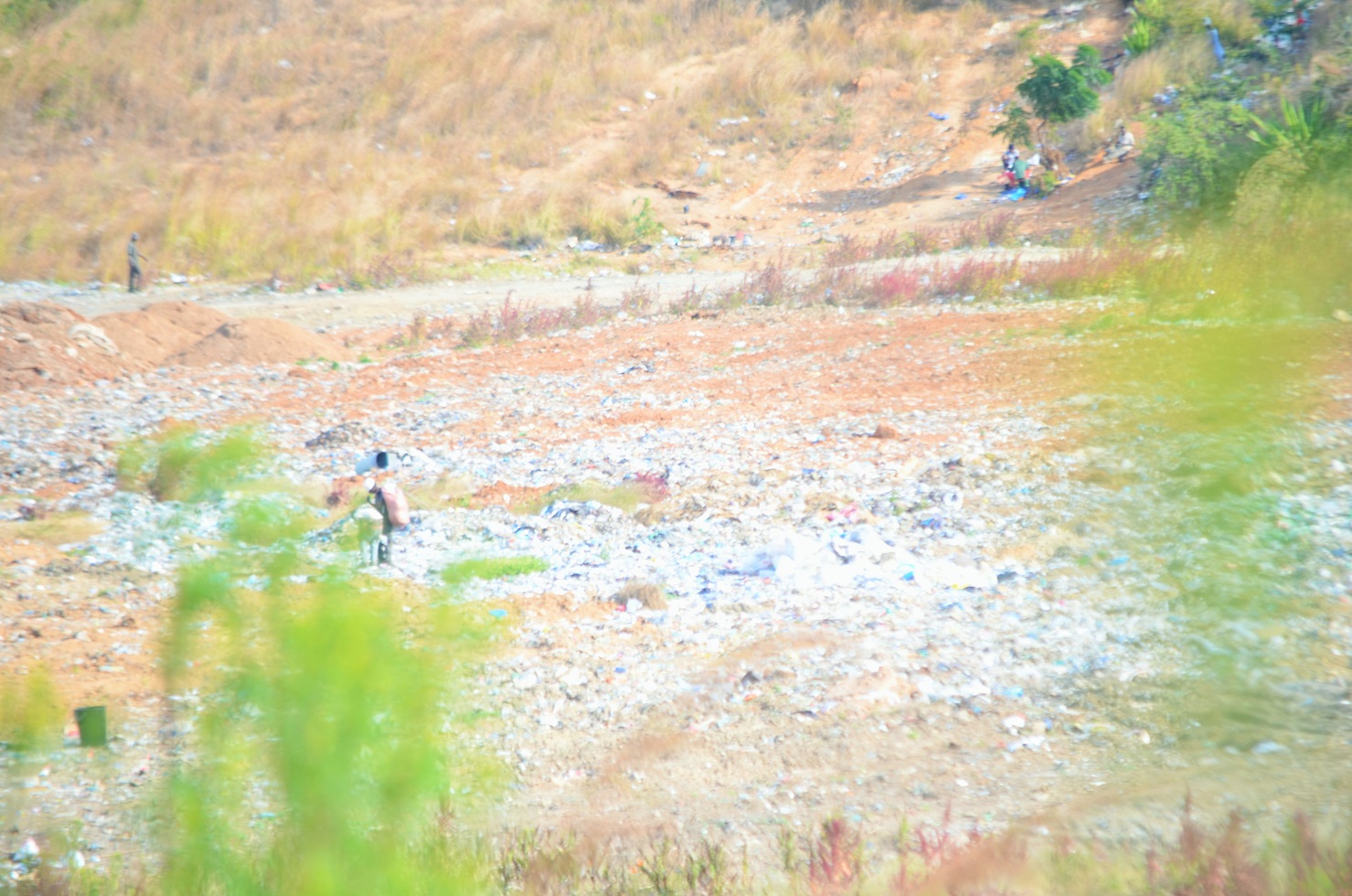
Mutare’s waste management predicament is compounded by a foundational failure: it has no proper landfill.
The city has been operating without an approved dumpsite compliant with environmental management legislation. The site in use was situated near a river, with residential development encroaching around it—a location the Matabeleland Institute for Human Rights described as “unsuitable for continued use.”
In 2020, Mutare City Council announced it needed US$1 million for the establishment of a new solid waste landfill in Gimboki. An environmental impact assessment had been carried out. Five years later, the landfill remains unrealised.
In January 2025, Geo Pomona Waste Management noted that Mutare had “made progress with our landfill, including borehole drilling in 2024 to monitor groundwater quality”—a small step, but one that underscores how far the city remains from an engineered, environmentally sound disposal facility.
Without a proper landfill, waste is dumped in what is effectively an open pit. Without separation, plastics mix with organic waste and are frequently burned, releasing toxic fumes into the air.
The recycling mirage
If the absence of a landfill is a structural failure, the absence of recycling services is a policy one.
Mutare City Council spokesperson Charles Sadondo told The Herald that plastic waste generated in Mutare is being recycled in Harare—transported nearly 300 kilometres west.
“Mutare City Council has not yet adopted waste separation from the source, but we are actively planning to work on this initiative to improve waste management practices,” Sadondo said.
“Council is collaborating with cooperatives and private sector players who scavenge for commercial and domestic waste, and transport it to Harare for recycling. This helps to promote sustainable waste management practices, create employment opportunities, and also contributes to environmental conservation,” he said.
This is not recycling infrastructure. It is waste export—a passing of the burden to informal pickers and distant processors, with no guarantee of environmental integrity.
A 2022 study in Mutare, published in Scientific African, quantified the scale of the missed opportunity. Researchers measured solid waste from 23 households per suburb across Dangamvura (low-income), Yeovil (middle-income) and Hospital Hill (high-income).
They found that about 84 per cent of materials in waste bins were recyclable. Readily recyclables—plastic, paper and metal cans—constituted 44 per cent. Yet at least 70 per cent of residents in Dangamvura neither reused waste nor practised off-site recycling.
The economic cost is staggering. Through improper waste handling, Dangamvura alone loses nearly US$45,000 per month in potential income from readily recyclable materials—money that could provide an income of approximately US$500 per month for 90 families.
The great deception
Yet even if collection improved, a deeper cynicism pervades Mutare’s waste management.
Residents in Sakubva have been documented practising waste separation, reduction, reuse and recycling. Individuals have received training in waste separation techniques through programmes supported by the city council and EMA. The civic consciousness exists.
The infrastructure does not.
The deception is this: residents separate their waste in good faith, only to watch it loaded onto the same refuse collection truck as all other garbage.
The separation is performative—a gesture that satisfies environmental awareness while achieving nothing. There is no segregated collection, no dedicated recycling stream, no verifiable pathway from kitchen bin to reprocessor.
As environmentalist Wellington Madumira, coordinator of the Climate Action Network Zimbabwe, told The Herald: “If residents are properly educated on how they can benefit from waste, there will be reduced pollution as all waste will be properly disposed for recycling”.
But education without infrastructure is theatre. Shamiso Mupara a recycling expert and director of Environmental Buddies Zimbabwe views the appearances of waste seperation as a scum even.
Scavenging as survival
For the poorest residents of Mutare, however, the dumpsite is not a problem to be solved. It is a livelihood.
In 2017, this reporter documented the lives of scavengers at Mutare’s dumpsite. Tens of young people were living off the city’s refuse, ploughing through rot without protective clothing to recover whatever they could—raw materials, items for repair, or collection for sale to recyclers.
“We have no choice and we will do anything that is not criminal to put food on the table,” said James Bvurere, who commuted to the dumpsite from Dangamvura and paid the council three dollars a month for access.
Dhanana Gananda made exquisite homemade toys from discarded materials but refused to be photographed. “You can’t take pictures of me because I’m essentially producing children’s toys from a toilet. Just look at how many diapers are in this place and a place where human excreta is deposited is a toilet, so please no pictures.”
Dzikamai Manzungu, who made traditional musical instruments, earned around US$30 a month. He and his fellow scavengers tried to look good—”like any ordinary person if we are going to make any sales.” They wore trendy denims and sneakers they had picked and mended at the dumpsite.
“We sell plastic at US$25 a bale to recyclers from Harare and supply scrap metal and aluminium to the green market,” said Tabarwa Tabarwa. They sometimes found live and dead babies in the dirt, brand-new clothes, electrical appliances and stashes of cash—finds that were never enough to lift them out of poverty.
The dumpsite scavengers are the invisible face of urban poverty. As Passmore Nyakureba who was then chairing ZimRights noted at the time: “The poor may appear hidden from public view but the situation is getting even worse. We may take pride in not having slums like other African cities but many people are still packed in temporary shelters, and areas where their lives and health are constantly under pressure.”
A decade later, little has changed. The scavengers remain. The dumpsite remains. The plastic keeps coming.
Citizen action, official inaction
Against this backdrop of institutional failure, citizen groups have stepped into the breach.
The Mutare Rivers Rehabilitation Initiative (MRRI), led by Lynne James, has spent more than four years engaging authorities to address river pollution.
Speaking at the Mutare River Conservation and Business Forum in 2026, James said: “For four and a half years, we have worked with EMA and the City of Mutare, and we have found it incredibly frustrating. We write letters, we have meetings, we communicate constantly, but we have achieved very little”. She described the pollution as a “28-year-old problem”—one the city acknowledged nearly three decades ago and promised to fix.
“Nearly three decades ago, the city acknowledged the issue and promised to deal with it, but we are now in 2026, and the river is essentially polluted,” she said.
James has also warned that the impact of the sewage discharge goes beyond Mutare, as the Sakubva River carries pollution downstream to communities such as Dora that depend on the water. “The amount of sewage that is flowing out of that is a total disgrace and it is all going into Sakubva River before the Gimboki sewage plant. The communities downstream have to use this water and that is a serious environmental issue,” she said.
In an interview with The Weekly, she confirmed that MRRI was edging closer to signing a Memorandum of Understanding with the City of Mutare, saying: “The document (MoU) is basically an agreement saying that the 2 parties will join hands, and that MRRI, within its capacity, will assist with the Rehabilitation and protection of Mutare’s wetlands and rivers, and that COM will enforce the relevant environmental by-laws that they have the full power in law to enact”.
She added: “Why these by-laws have not been enforced to date is totally unacceptable, and the result is the environmental crisis that Mutare now faces”.
“Our environment has never before been under such pressure from human activity,” James said.
In the Vumba mountains, the Friends of the Vumba Trust, chaired by Sue Fenwick, actively cleans up roads that are predominantly littered with plastic. The trust spearheads environmental education, clean-up campaigns and fire protection initiatives aimed at safeguarding the natural beauty that attracts visitors to the region.
Fenwick has urged learners to embrace proper waste disposal, noting that improper disposal of tougher materials such as rubber and plastic bottle tops is detrimental to the environment.
These are commendable efforts. But they are volunteer-driven, resource-constrained and no substitute for the municipal waste management systems that should exist.
A regional and international lens
The crisis in Mutare is not isolated. Zimbabwe is part of a five-year, US$90-million regional initiative with Kenya, Nigeria, South Africa and Uganda, supported by the UN Environment Programme, to reduce hazardous chemicals in plastics.
The project—titled “Circular and Persistent Organic Pollutants-Free Plastics in Africa”—aims to “make sure that recyclers are capacitated to reduce the amount of waste going to dumpsites, but also make sure they are not exposed to this pollutant.”
The government is also pushing for extended producer responsibility, with enforcement proposed in the review of the Environmental Management Act, now at bill stage, as well as a statutory instrument currently at draft stage.
As Sidange put it: “This new SI again will promote reduction of post-consumer waste as producers will be held accountable to their brands becoming a pollution menace.”
Meanwhile, at the global level, negotiations for a legally binding plastics treaty have stalled. The second part of the fifth session of the Intergovernmental Negotiating Committee (INC-5.2) was held in Geneva from 5 to 15 August 2025.
It concluded without consensus. UN Secretary-General António Guterres expressed regret that, “despite earnest efforts, negotiations to reach an international legally binding instrument on plastic pollution concluded without achieving a consensus.”
The treaty remains elusive. The plastic does not.
The long shadow
The polyethylene terephthalate (PET) bottle was first patented in 1973. By 2024, global production had reached approximately 480 billion per year—roughly one million bottles produced every minute somewhere in the world.
The same chemical properties that make PET so useful as a packaging material also make it extraordinarily resistant to natural decomposition.
A standard estimate for a PET water bottle is approximately 450 years to fully decompose under normal environmental conditions—a figure compiled from research used by the NOAA Marine Debris Program to compare degradation timelines of different kinds of ocean litter.
Since PET has only existed for about fifty years, no bottle has yet been observed to fully decompose in nature.
Other sources put the upper bound at 1,000 years for full breakdown into the smallest measurable particles.
Either way, the basic finding is unambiguous: essentially every PET bottle ever manufactured is still present on Earth in some form.
What plastic does instead is fragment. Sunlight, mechanical stress and oxidation slowly break it into smaller and smaller pieces.
Microplastics have been found in every major ecological compartment scientists have examined—including snow samples collected from ice floes in the Fram Strait, thousands of kilometres from any major source of plastic pollution.
In a 2019 study published in the journal Science Advances, researchers led by Melanie Bergmann of the Alfred Wegener Institute found approximately 14,000 microplastic particles per litre in snow from an ice floe in the Fram Strait off eastern Greenland.
In Mutare, the fragments end up in the soil, the rivers, the air, and the bodies of the people who live and work among them.
The way forward
Mutare City Council has expressed interest in partnering with Geo Pomona Waste Management to tackle the city’s waste disposal challenges.
The company has converted thousands of tonnes of waste into energy and reusable materials in Harare. But a partnership is not a solution.
A solution requires political will, regulatory enforcement and—most critically—a recognition that the convenience of a free plastic bag carries a cost that someone, somewhere, will eventually pay.
Joyce Chatora will continue wrapping her fruit in thin plastic. The scavengers will continue picking through the dumpsite. The rivers will continue to carry plastic downstream. The cancer wards will continue to fill.
And the laws will remain on the books, unenforced, until someone decides that the convenience of a 50-cent purchase is not worth the price of a city’s health.
Do you have a story to share? Email bchiketo@gmail.com