






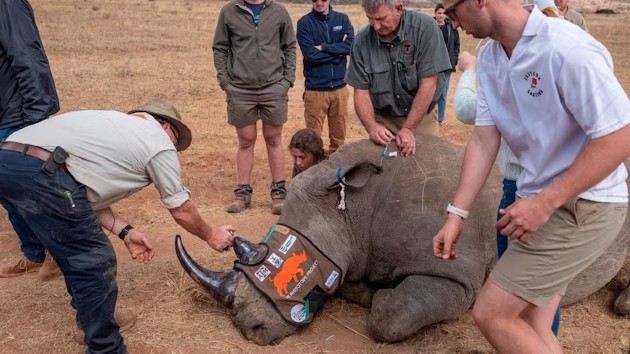
Rhino horn is still flowing from Africa to China—carved into bracelets, not just medicine
by NORMA TSOPO
AT THE turn of the 20th century, an estimated 500,000 rhinos roamed the wild. Today, fewer than 27,000 remain, and a rhino is killed every 15 hours.
The horn, composed of keratin – the same protein as human hair and fingernails – can fetch up to $20,000 per kilogram on the black market.
Most of it ends up in China, not as medicinal powder, but carved into pendants, bracelets, and libation bowls.
A March 2026 report by the Environmental Investigation Agency (EIA) analyzed 258 rhino horn trafficking cases prosecuted in China between 2013 and October 2025, drawn from the China Judgements Online database.
The verdicts reveal that southern Africa remains the primary source.
Mozambique and South Africa dominate as both origin and transit points, with horns often routed through Kenya, Qatar or the United Arab Emirates before reaching Chinese markets.
Across the 258 cases, Chinese authorities seized 700kg of horn, implying that some 200 rhinos were killed to supply just those documented shipments.
The courts convicted more than 500 traffickers, who received average sentences of four and a half years and fines of about 92,322 yuan ($13,540).
White rhino horn was named in 91 cases, black rhino horn in 25. One case involved the greater one‑horned rhino.
Full horns accounted for 14 seizures, powdered horn for 18. Almost all seized products came from African species.
Despite a 16% decline in South Africa’s rhino poaching in 2025 – 352 animals killed, down from 420 in 2024 and 499 in 2023 – the pressure inside Kruger National Park sharply intensified, with 175 rhinos lost compared to 88 the previous year.
Poaching has now endangered three of the five living rhino species.
A 2022 report by the Convention on International Trade in Endangered Species of Wild Fauna and Flora (CITES) makes clear that this is not merely a conservation crisis.
It is a security threat: seizure data shows convergence with firearms, illicit drugs and other commodities in about 10% of rhino horn cases, enmeshing the trade with international organised criminal networks that also deal in ivory and heroin.
CITES has called on source, transit and destination countries to redirect their efforts “in an effective, coordinated, and enduring manner”.
The EIA report offers one of the few systematic glimpses into China’s role as the largest consumer, but it is necessarily incomplete.
As Susan Lieberman, vice president of international policy at the Wildlife Conservation Society, told Mongabay, court case analysis is “the ‘tip of the iceberg’, and is dependent on enforcement efforts and the nature of cases that actually go to court.”
What is certain is that the horns still flow, the networks still operate, and for every trafficker caught, many more are not.
Do you have a story to share? Email bchiketo@gmail.com