





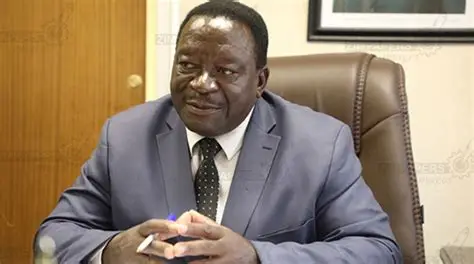
Victor Matemadanda, Zimbabwean diplomat, liberation veteran and ZANU-PF commissar, died on June 20th, aged 66
by STAFF WRITER
THERE was a certain restlessness to Victor Matemadanda. He was a man who seemed to have lived several political lives, each more improbable than the last.
He had been a teenage guerrilla in the Mozambican bush, a firebrand war-veterans’ leader who helped topple a president, a deputy defence minister and, finally, the diplomatic face of his country in two neighbouring states.
When news of his death came on a Saturday night, the official announcement was characteristically spare. The cause was not given. Unconfirmed reports whispered of poisoning. In Zimbabwe, such silences are fertile grounds for theories.
Born in Mvuma in March 1960, Matemadanda was still a schoolboy when he answered the call to arms.
He joined ZANLA, the armed wing of ZANU, in 1973—or, by some accounts, 1976. The dates blur, as they do for men who spent their youth in the bush.
He moved through Mozambique and later worked in Zambia organising logistics for the war effort.
That was his formation: the liberation struggle was not an ideology but an experience, one that would define him long after independence was won in 1980.
In peacetime, Matemadanda became the public face of the war veterans’ movement. He served as secretary-general and later national chairman of the Zimbabwe National Liberation War Veterans Association.
He was a fierce defender of the veterans’ cause, and just as fierce a defender of ZANU-PF.
In 2017, as factional battles within the ruling party reached their zenith, it was Matemadanda who stood before the cameras and declared that the relationship with Robert Mugabe had “irretrievably broken down”.
The military intervention that followed—codenamed Operation Restore Legacy—removed Mugabe from power and brought Emmerson Mnangagwa to the presidency. Matemadanda had been one of the public voices clearing the path.
His reward was a seat at the table. He became ZANU-PF’s national political commissar, the party’s ideological enforcer.
He was elected Member of Parliament for Gokwe Central and appointed Deputy Minister of Defence and War Veterans.
In 2021, he was redeployed to Maputo as Zimbabwe’s ambassador to Mozambique, with concurrent accreditation to the Kingdom of Eswatini.
It was a curious posting for a man whose reputation was built on confrontation rather than conciliation.
Yet those who worked with him in Maputo described a diplomat who took the welfare of Zimbabweans abroad seriously—someone who saw his role not as ceremonial but as a duty of care.
He continued to evolve. In 2022, at the age of 62, he completed a doctorate in Business Administration. It was a reminder that he never considered his education, or his service, finished.
He remained active in the war veterans’ association even as ambassador, contesting its leadership elections as late as 2024.
That restless energy—the inability to retire from the fight—was both his strength and his limitation.
Matemadanda was, above all, a man shaped by struggle. He could be forceful, even brutal, in public life, never one to shy from a hard position. But beneath that was a man devoted to family—a husband and father to his son Terrence.
His death marks the passing of another link to the generation that fought for Zimbabwe’s freedom. That generation is dwindling. And as it goes, so too does the legitimacy of the party that claims its mantle.
His country remembers him. Whether it will learn from him is another question.
Do you have a story to share? Email bchiketo@gmail.com