






by BERNARD CHIKETO
IN MANICALAND seasonal rains can sever communities from schools, clinics and markets so infrastructure is not an abstract concept but a determinant of daily life.
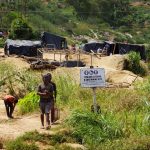
The recent commissioning of the Premier South Footbridge, a $70,000 structure spanning a perilous crossing near an active mining area, represents more than just steel and concrete.
It is a modest yet deliberate step in government’s strategy to tackle isolation and safety—one careful footfall at a time.
Advocate Misheck Mugadza, the Minister of State for Manicaland Provincial Affairs and Devolution, presided over the opening.
In a statement reflecting a pragmatic approach to development constraints, he noted the bridge “addresses critical safety and connectivity challenges” for a vulnerable community.
The project’s immediacy lies in its function: replacing a hazardous crossing with a safe passage for children, market traders and miners.
This focus on foundational, human-scale infrastructure is a quiet feature of the province’s planning.
The ceremony served as a platform for forward-looking announcements.
Minister Mugadza confirmed that two additional footbridges are slated for construction at Tsvingwe and the notoriously flood-prone Nyamukwarara area. The latter has long been a major concern, effectively cutting off communities during the rainy season.
This sequential, project-by-project approach suggests a methodical, if gradual, plan to erode the province’s most pressing connectivity barriers.
The engagement also revealed the dynamic between local authorities and community stakeholders.
While welcoming the improved access, attendees like Senator Chief James Mutasa did not hesitate to advocate for more ambitious projects. The chief emphasised the eventual need for vehicle bridges to facilitate broader economic activity and transport heavier loads.
Notably, the minister’s response was to acknowledge these views, framing them not as criticism but as integral to future planning. “These views were noted,” the minister stated, “reinforcing the importance of development that matches community needs and economic realities.”
This exchange hints at a collaborative, if aspirational, roadmap.
For Manicaland, the footbridge is a single node in a wider network of planned improvements. Provincial authorities speak of a “clear development trajectory,” encompassing everything from agricultural support to service delivery reforms.
In this context, the bridge is both a tangible asset and a symbol—a demonstration of the state’s presence and a prerequisite for more complex growth.
It is harder to attract investment or improve livelihoods when basic mobility is a daily risk.
Do you have a story to share? Email bchiketo@gmail.com